Saturday, May 16, 2020

Meet Finnia Chocolate & Cacao

Now that the Covid crisis seems to be settling in to some kind of 'new normal' and I have a little more time to finally sit down and write a blog post (sorry for the year-long hiatus, it's been a busy one), I thought it was time I introduced you to my own business, and told you about the changes that have taken place over the last several years.

For nearly 11 years, I've run a small little chocolate business way up here on Manitoulin Island in Northern Ontario. It was called Ultimately Chocolate, because when I started out I made a mixed bag of goodies: chocolate, cakes & cupcakes, and pastry. I quickly chose a name to let everyone know that ultimately, I am all about chocolate. So don't be ordering date squares and lemon squares and cookies from me. That wasn't my thing and it never would be (although I do make a mean lemon buttercream). I make chocolate. And when I make a cake, it is chocolate, or at least mostly chocolate.


But as I delved deeper into the business, I discovered the world of chocolate can go much deeper and darker than double-chocolate cheesecakes and dark chocolate truffles. I fell in love with bean to bar chocolate more than 10 years ago, and slowly it took over my business and my life.

So now I've been making bean to bar chocolate in one form or another for at least five years, although I was making a gritty form of bean to bar for a few years prior in my coffee grinder (that's right, you can grind up cocoa beans in your coffee grinder with sugar!). It came naturally since I'd been tasting every bean to bar chocolate that I could get my hands on for the five years prior to that. I knew what kind I wanted to make, and what textures I loved (very smooth and creamy, although I often love the gritty stuff too).


So the business has grown and I finally made my way off this literal island I live on, and also beyond my hometown of Sudbury, Ontario as well. My chocolate can be found in stores around Ontario and as far as British Colombia. Some awards have been won the last two years at the Northwest Chocolate Festival and in the International Chocolate Awards. So the business has certainly grown.

And with all that growth came change. I now have an amazing business partner (Trish) who has helped me to propel the business forward in ways that I never considered or had time for. We've moved the business out of a small commercial kitchen that was in my home to a small production studio in downtown Gore Bay. There is a small staff (well, was prior to the pandemic and hopefully will be back at work soon) and much larger equipment. And we are planning a move to a larger space to not only increase our capacity, but have a storefront finally to serve local customers and tourists.

So all that said, meet Finnia. That's right, we outgrew our name and decided to re-brand Ultimately Chocolate to something simpler, and something more meaningful to me.


I grew this business with my children in tow, who watched it grow every step of the way. With a home-based business, I was able to let my kids come home after school several days a week, and only go to daycare part-time. So they have been right there with me the whole time. And now at 11 and 8, the new name reflects these two little inspirations in my life. My son, Finn, loves all kids of chocolate, but in particular shares my love of dark chocolate. My daughter Fia prefers white chocolate to all other kinds of chocolate, but will sometimes indulge in milk chocolate too. So these two have been my tasters for many years, and my inspiration.

Too often I can take the chocolate a little too dark. I like my 'darks' very bitter and my 'milks' also on the darker side.  Finn and Fia bring me back down to earth, and help me see what the general population would enjoy, while balancing my preference for low-sugar chocolate. Fia reminds me that white chocolate is delicious too, so inspires me to explore it further. Finn is an inspiration for a lot of the dark chocolates I make. All the while, I explore the cocoa beans and seek to highlight the flavours of each bean in any new creation.

So there you have it, Finnia is the new name of the business. Fia and Finn are the reason I moved to this Island (Manitoulin Island), and had I not moved here, I may never have left the marketing career I was building in Ottawa. And I might still be stuck in a cubicle in some office sitting down all day (I hate sitting down!).  So I am thankful for them, and for the love of chocolate which I have had all my life. I am also thankful for a year in France that showed me chocolate can be dark and pure and not at all sugary. And I am thankful to all the other bean-to-bar makers out there who have inspired me over the years. I will never copy your recipes, but will always enjoy learning from your path, your techniques and your tasty treats.

So here's to the next chapter. It may seem a little stuck right now during this time of Covid and business closures, but we are so far managing to pay the bills and keep the chocolate 'flowing' to our existing wholesale customers, including grocers, cafes and bean-to-bar specialty shops. If we can continue to weather this storm, the future will be much brighter for Finnia.

Finnia Chocolate can be found at Harvest Wagon,
a high-end, specialty grocer in Toronto.


Finnia can also be found at Belle's Bakery in Toronto.

So cheers for a love of craft chocolate! And cheers to a brighter future (even if it is a little unknown and unpredictable at the moment).

Cheers to a brighter future!

And cheers to the 'new normal' :-)

Tuesday, April 9, 2019

Bean to Bar Chocolate....at Costco? ChocXO Almond Butter Cups now on the shelves of Costco stores

I was spending a little time "off island" the other day, and made my way to Sudbury, Ontario, the nearest city to Manitoulin Island. I made my way into Costco for a few business supplies. As soon as I passed the snack aisle, I was surprised to see - not only a new product on the shelves, but a ChocXO product. ChocXO has been actively promoting themselves as a bean-to-bar chocolatier (they write 'chocolatier' rather than 'maker' I guess because they focus more on the treat market rather than just single origin bars like many other bean to bar chocolate makers).


I have always found ChocXO to be a bit confusing. I heard and read that they were a bean to bar maker, but in Canada or the US I could not figure out. They have a Delta, BC (Canada) address on their website, but I thought they started in California, or have a production facility there and one in Canada? Plus, the website uses the words 'color' and 'flavor' without the 'u', leaving me to believe it is American-based. The website no longer gives any indication verbally of the origin of the company, likely to let people believe it can be made in their local country no matter which side of the border they may be on.


What worries me for the craft, bean-to-bar chocolate community, is that clearly to achieve a price of $12.49 at Costco, there must be some large equipment and mass-production capabilities in place. This low price makes it hard for the average small bean-to-bar chocolate maker to explain why their price is six times the amount of ChocXO's. I calculated what my bean-to-confection price would be (based on weight) and this bag would retail at $60 for a small maker like me. Below that and I could not cover labour cost or overhead; I would lose money.

The growing group of craft, bean to bar chocolate makers take at least a week to produce a bar of chocolate from start to finish (that's if they don't age your chocolate before moulding it, which adds weeks to thee process). And with small equipment, and carefully sorting and roasting beans by hand, plus ensuring beans are fine-flavour, chosen from farms and farm co-ops applying sustainable methods and prices high enough for the farmers to earn a living, the whole process on a small scale is very expensive. But what the customer gets for that higher price is: knowing where the beans come from, being able to taste flavours of specific 'terrior' depending on where the beans grow, and knowing that a chocolate maker has put all of his or her passion into bringing out the most interesting flavours of the beans in the way that they have personally interpreted them. All this makes the experience for the taster unique for each brand, each year and each harvest time for the beans.

So all that said, I am happy for ChocXO for making it into Costco. This is a great leap for them as a business. I am just concerned that by promoting the 'bean to bar' message on their packaging, it makes it harder for the small makers to educate their customers on why ChocXO's Costco price is so different from their own.


As for ChocXO's product itself, I like the main principles of what they stand for: 100% organic and no artificial sweeteners, colours or flavours, and non-GMO and sustainable sourcing. These have always been my principles in my chocolate business and in my eating habits. I would gladly feed their products to my children as an alternative to a standard commercial chocolate candy bar, like Mars or Reese Peanut Butter Cups. And for those who cannot have wheat, they are also gluten free.

The Almond Butter Cups are tasty, and leave you wanting more. They are a bit on the sweet side being made with a 56% 'dark' chocolate (which means that chocolate around the almond centre contains 44% sugar). The centre doe not taste quite so sweet yet balances the chocolate very well. There is a good amount of chocolate also on these cups, which certainly satisfies a chocolate craving, but yet provides a filling snack when one is a bit hungry.


ChocXO talks about offering "responsible portion sizes" on their website, and I agree that the individually wrapped packs are nice and a way to control portions, however several cups come in a large bag, and so it is easy to just keep opening the individually wrapped packets and eating more than intended. For people with high self control who can just pop one or two into their purse or lunch bag for a work-day snack, that is great. But when you are shopping at Costco just before lunch and are getting hungry, it is too easy to frantically open the bag in the car and eat five in a row, leaving a trail of messy wrappers across the front passenger seat of the car (really, would I do this? Not me. Nope. No way. Sigh, I still have to go clean out my car.)

So check these out at Costco if you are into Almond Butter Cups, or looking to kick your commercial-Reese-Peanut-Butter-Cups-hydrogenated-oil-and-artificial-flavour habits and want something a little 'healthier'. Just be sure to hit up Costco on a full stomach first!

Friday, March 15, 2019

Amazing Cacao, Russian Bean-to-Bar Chocolate

A few months ago I was handed a package of bean-to-bar chocolate made by a Russian company. This is my first experience with Russian craft chocolate, so I was curious.


I thought I was about to eat a bar of chocolate, but what I found inside the wrapper was a lovely package of eight different chocolates. Each chocolate is made from a different cacao grown in different regions of Peru. The box also included many single region 70% to 75% dark chocolates, one lovely, not-too-sweet white chocolate, and an 80% dark-milk with no sugar in it at all (much like Zotter's unsweetened 70% milk chocolate 'dark style' and Hotel Chocolat's 80% Supermilk, two dark milk chocolates with just milk powder, cocoa beans and cocoa butter, and no sugar added). This 80% was very bitter, and definitely took some getting used to, but certainly a little easier on the palate than a pure 100%, thanks to the milk content.


If you like to taste a variety of single origin chocolates in one sitting, or over the course of a week or month, this tasting package may be the perfect thing for you. It was fun to taste the variety of flavours of cocoa beans from different regions of Peru. I had some favourites, and some not-so-favourites, but I will let you decide for yourself which regions you liked best.

What was most exciting about this product was the origin and taste discovery experience inside. There are so many single origin chocolates coming out of Peru and made from Peruvian cocoa beans now, that it can get confusing and overwhelming to pick a favourite region. This box offered a lovely overview of Peruvian cacao and some of the cacao growing regions in the country.

You can learn more about Amazing Cacao on their website: http://www.amazingcacao.com/about They also import to Russia organic ingredients, such as green coffee beans, fine organic cacao beans and cocoa butter and cane sugar.

Happy Chocolate Tasting!

Monday, February 18, 2019

The Winter Chocolate Show: The Best Ever Bean to Bar Chocolate Event in Toronto

As European chocolate makers, chocolatiers and chocolate lovers are getting ready for Chocoa in Amsterdam later this week, I am still reminiscing about The Winter Chocolate Show in Toronto a few weeks ago. It was much smaller than the beast of an event Chocoa is, but it was exciting none-the-less for Canadian chocolate makers and chocolate lovers because it was the first Canadian bean-to-bar event of its kind.

Organized by Erik of Desbarres Chocolate and Paola of The Candy Bar Toronto, the festival was a one-day event that brought together 16 Canadian bean-to-bar chocolate makers from all across the country (really, all across - from Nova Scotia to Victoria!).  Chocolate lovers and connoisseurs poured through the doors all day long into the small venue at the Enoch Turner Schoolhouse in downtown Toronto. 

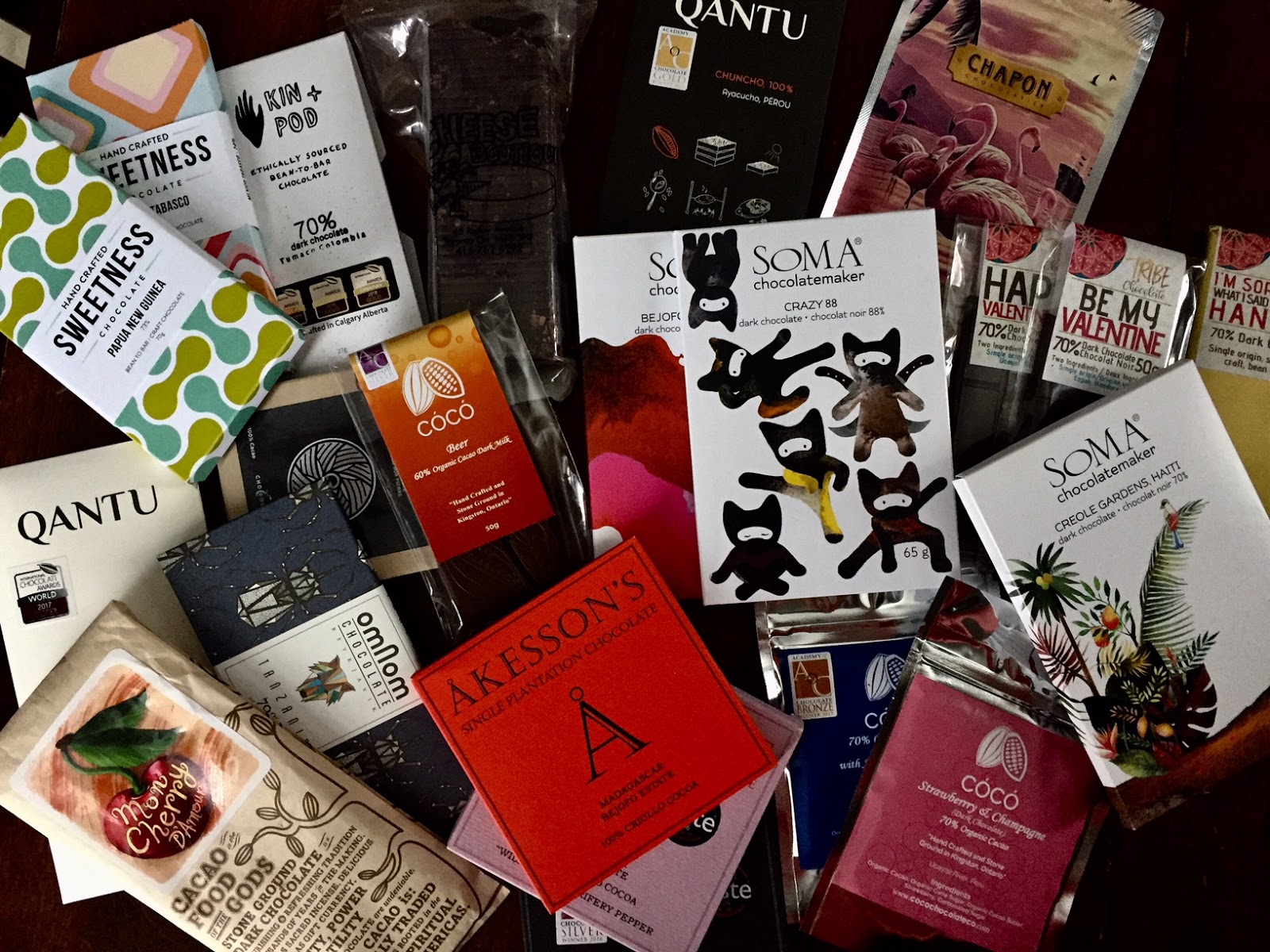
Look at all the beautiful bean to bar chocolate that I brought home from Toronto!
Akesson's came from The Cheese Boutique, Omnon from Pusateris and Chapon from The Candy Bar.
The rest are all the wonderful Canadian bean-to-bar chocolate that was found at The Winter Chocolate Show!

I was there, not as a chocolate lover this time in the way that I annually attend the Northwest Chocolate Festival in Seattle, but as a chocolate maker. I've been quietly making chocolate for quite a few years now as part of my 10-year old confection and pastry business, but last year I finally made the decision to sell my bean-to-bar chocolate beyond the local market of Manitoulin Island and Sudbury. And I was finally brave enough to send a few of my bars off for some of the international awards (and won a few too!).  So now that I am venturing out into the world beyond Northern Ontario, I was excited to have a chance to participate in a bean-to-bar event so close to home (ha ha, it took me 8 hours in a snowstorm and freezing rain to get there, but it was still driving distance!). 

The day was so much fun. I was surprised to see how many people knew about bean to bar chocolate (although I shouldn't have been since Soma has been educating customers for years in Toronto), and many looking for interesting single origins, flavour combinations and 100% dark chocolate. We had a few bloggers out, including Christie from @twogirlschocolate and Cyndi from @canadianchocoholic, and Grand Jury judge for the International Chocolate Awards, Shirley Lum (@schocolatemagic). The wonderful craft chocolate expert and educator Karine from www.misschoco.ca joined us from Montreal. And I got to hang out with my business partner Trish and my best friend Katherine all day long, talking chocolate with a lot of passionate people.

Can you spot Miss Choco and @Canadianchocoholic?


We also had the privilege of wonderful Juan Gonzalaz from The Mexican Arabica Bean Company wandering around the show all day, talking to people about his beautiful cocoa beans from Honduras, Mexico, Peru, Papua New Guinea and soon, Thailand. Juan is a good friend and excellent partner to bring fine flavour cocoa beans direct from the farm to Canadian chocolate makers like myself. 

That's Juan with the hat! And me on the left of course :-)
And look at that beautiful branding by Desbarres in the backgound.


As for the vendors, we had a variety of chocolate makers sampling their products, from stone ground chocolate like ChocoSol, to super smooth like Soma Chocolatemaker, both from the Toronto region. David and Cynthia from Soma are in the middle of a big project (moving to a much larger bean to bar factory in Toronto) so it was great that they joined us. Desbarres Chocolate had all their wonderful award-winning flavours, like that delicious black pepper and cardamom bar that I have been thinking about since I first tasted it in the Fall. 

Taylor Kennedy flew in all the way from Victoria, B.C. with his award winning chocolate bars and he surprised us all with the launch of new packaging. Still with a lovely shade of yellow, this new packaging wowed with a theme of wildlife native to the seas surrounding Victoria. The chocolate bar mould was even re-designed with a stylized wave. What a beautiful way to showcase the origins of Sirene Chocolate. Congratulations to Taylor on a job well done!


Other notable mentions were Coco Chocolate Company's Strawberries and Champagne bar, with freeze-dried strawberries and carbonated sugar for a fizzy effect, Sweetness Chocolate's artistic single origin bars with splashes of colourful cocoa butter, Soma's beautiful valentine's day chocolates, Palette de Bine's new large gorgeous pack of bars with a beautiful illustration of Mont Tremblant, and Tribe Chocolate's packaging with the cute saying "I'm sorry for what I said when I was hangry." Petite Patrie flew in from Nova Scotia and brought some good single origins and an interesting vegan chocolate. Kin + Pod represented Calgary by show-casing its award-winning Tumaco bar. I also featured my new Buttermilk Gianduja bar, which is a creamier version of the award winning Buttermilk 48% with hazelnut butter and sea salt added. It is quite delectable. 


I wish I had a chance to make it around to all the tables and buy more chocolate! But alas, it was a busy event with a lot of excited chocolate lovers, so I was talking chocolate with customers most of the day, which is one of my happy places to be :-)

Next year we hope to see the event back and perhaps even bigger!  What a great way to spend a cold winter day in Toronto. I hope to see you there next year!

Sunday, January 13, 2019

No Cane Sugar Hot Chocolate Recipe - Quick and Simple and Healthy

Are you still tackling your New Years Resolutions to be healthier in 2019? And is one of those resolutions to reduce or cut out cane sugar? If so, making hot chocolate can be no easy task since most hot chocolate mixes have added sugar in them. Even gourmet 'drinking chocolate' can be full of sugar. But fear not, hot chocolate with alternative sweetener is easy to make at home with an unsweetened chocolate bar and your healthy sweetener of choice, whether it be stevia, xylitol, coconut sugar, maple syrup or yacon syrup.


Although it is quick and simple to make a hot chocolate out of pure chocolate, it does take a bit of technique when it comes to pouring and stirring to make one that is smooth, with no bits of chocolate floating in it, which maximizes chocolate flavour. The key is to start out by making a ganache, then add all the milk (or coconut milk for a vegan version) that you want.

As part of my 'go dark' winter months, I was tasting this Montezuma 100% dark chocolate bar:


I liked it, but it was a little mild in the single-origin cacao flavour department for me. I knew I was never going to finish it as an eating chocolate. But I thought - because it was low in acidity and any overwhelming fruity or pronounced flavours - it would be perfect for a hot chocolate. And in the end, it was!

I also tried a few other 100% dark chocolate bars that I raided from my tasting cabinet...


And in the end, I settled on my version of the perfect no-cane sugar hot chocolate. Here is my recipe:


No Cane Sugar Dark Hot Chocolate Recipe:
Makes 3 servings.

Ingredients:75 grams 100% dark or unsweetened chocolate
2 1/3 cups milk (2% to 3%) or coconut milk (or another alternate milk of choice)
4.5 tsps maple syrup, coconut sugar or yacon syrup, or 9 drops of concentrated stevia
1/4 tsp real vanilla extract

Instructions:

1. Place milk in a small saucepan on the stovetop. Heat on medium, stirring often, until steaming.
2. While the milk is heating up, break up your chocolate into 1/2" pieces. Place chocolate in a small-to-medium sized microwave-safe bowl. Add 3 tbsp of the milk to the chocolate. Microwave for 35 to 40 seconds. Stir until smooth.
3. Add the sweetener, then add a little bit more of the hot milk (about 1/4 cup) and stir in until smooth. Add the remaining milk and vanilla extract and stir with a spoon or whisk until smooth.
4. Pour 1/3 of the mix into one mug and enjoy immediately. Cover the remainder with plastic wrap and refrigerate until ready to consume (no longer than three or four days though). Warm up in a mug in the microwave or in a saucepan and enjoy!


Tips & tricks for making hot chocolate with less sweetener: 

Sweeten your hot chocolate to your own taste and do what you are comfortable with. I found 1.5 tsp of maple or yacon syrup to be sweet enough with a mild-flavoured chocolate like the Montezuma or a mild Peru or Venezuela origin 100% dark liquor. However, when I've made the same recipe with a Madagascar, Grenada or other more citrusy or acidic unsweetened chocolate, the same recipe results in a much more bitter hot chocolate. If this happens to you, or you find my recipe too bitter for your taste buds, you can do the following to make it taste sweeter without adding more caloric sweeteners:

-add more skim or low fat milk, the natural sugars in the milk will more than make up for any added sweetener and reduce the bitterness by quite a bit.

-add a touch more real vanilla. Vanilla certainly makes chocolate taste sweeter than it is, and it also works the same way in hot chocolate.

-even if you don't like the taste of stevia and you've chosen maple syrup or honey or some other sweetener with more calories than stevia, you can still add a drop or two of concentrated stevia without it adding the taste of stevia. Anything over that amount and you might start to taste the stevia, but supplementing your maple syrrup with just a bit of stevia will not affect the flavour too much. If you like the taste of stevia, go ahead and use it entirely as the sweetener, but remember not everyone does so if you are serving to others, keep that in mind.

-blend in a half of a ripe banana and don't add any sweetener. This will become a banana-flavoured hot chocolate, but hey why not? It's a meal and a treat all in one!

-go darker. Cut the sweetener to half of my recipe, or don't add any at all. You will eventually become used to the bitterness if you have decided to cut all sweeteners from your diet.

Saturday, January 5, 2019

Unsweetened January: Chocolate with low or no cane sugar, TAZA Wicked Dark 95% dark chocolate

Happy New Year my chocolate-loving friends!

As another year passes, I notice how much more choice we have in chocolate. With the rapid and massive growth of the bean-to-bar chocolate industry, any percentage of cocoa solids and flavour combination can now easily be purchased - if not in person, certainly online. And so, each January since I started an annual tradition of cutting back the sugar in the chocolate I consume, and eating only very low-sugar chocolate (we're talking 80% to 100% dark chocolate) for the first two months of the year, my goal has become easier to reach.

When I first started this 'unsweetened' tradition in 2012, I did it to get my palate accustomed to 100% dark chocolate so I could begin to enjoy it. Well, that plan worked and now I can not only easily jump between a white chocolate bar and a completely unsweetened cocoa liquor without so much as a cringe, I also find myself hoarding the very darkest of bars and tucking them away for the winter months, happily looking forward to my unsweetened chocolate time.

But of course one need not jump headfirst into darkness, but rather ease in tentatively to become accustomed to the dark. So I thought I'd start by some 95% dark chocolate bars by TAZA CHOCOLATE, a bean to bar chocolate maker from Somerville, Massachusetts.


In November at the Chocolate Maker's Unconference, I attended a few sessions lead by Alex Whitmore, the charismatic founder of TAZA, and was both surprised and impressed to hear that TAZA's number one selling product is a 95% dark chocolate bar called Wicked Dark. With only 5% sugar, the bitterness level of this bar has in the past been too much for most chocolate lovers, until recently. With a renewed interest in cacao and much talk of Keto and Paleo diets, very dark chocolate has entered its heyday, and the average population is beginning to try it.

Because of the popularity of Wicked Dark - or at least I assume this to be the reason - TAZA also has introduced the Wicked Dark 95% bar with Toasted Quinoa. So I purchased both bars online, arriving back from Christmas Holidays to find them in a package at the post office. Perfect timing for my unsweetened chocolate month!

Wicked Dark truly is the perfect name for these chocolate bars. They are bitter, in nearly a wicked way. But with the crunch of the stone-ground chocolate, they have a snack-like quality, and just enough crunchy sugar to make you not feel as though you are missing out on a chocolate experience. Taza's focus, as they mention on their website, is that cacao is complex in flavour, so they minimally process it so the flavours can "shout loud and proud". These chocolate bars certainly do that.

Can you handle it?

If you think you can go wickedly dark, learn more on Taza's website at: www.tazachocolate.com or if you are in Canada like I am, you can buy Taza bars online at www.naturamarket.ca.

The Wicked Dark bars by Taza are certified organic, non-GMO, direct trade, gluten-free, dairy free, soy free and vegan. The ingredients are: organic cacao beans, organic cane sugar, plus puffed quinoa for the toasted quinoa bar.

Stay tuned for more talk of unsweetened chocolate bars and low- or no-cane sugar chocolate in the coming two months! Happy Chocolate Eating!

Sunday, December 9, 2018

Cacao Juice Now Available in North America - Pure and Perfect!

Have you ever wondered why, if cacao is a fruit, you haven't seen juice made from it like apple or orange juice? I have wondered the same thing. But now, you can drink cacao juice.


Repurposed Pod is the company behind this new beverage. The only ingredient is cacao juice, pressed from cacao fruit from Ecuador (cacao fruit also holds the cocoa beans that chocolate is made from). The taste of the juice is sweet, but also a little bit tangy and tart too. The acidity of the cocoa bean can be well explained when you taste this juice. 

I was so excited to see the juice at the Northwest Chocolate Festival this year at Indi Chocolate's table. It has been a little while since my last trip to a cacao farm and I was missing the taste of the fruit. I was surprised at how much I enjoyed the juicy fruit taste, since the descriptions had never made it sound appealing. Comments like "juicy white flesh" made me think it was going to be disgusting, however the actual taste was that of one of the best fruit I've ever had. 

The juice offers nutrition and a good source of magnesium, and a wonderful new flavour for your smoothies or as a base for mixed alcohol beverages. This is the next best thing to finally getting cacao pods imported to our grocery stores. 

I'm not sure if we can get this in Canada yet, but there is definitely a lot of distribution through the United States, where you can buy it on Amazon.com for about $3.99 per container. 

To learn more about Cacao Juice and the makers of this product, visit their website at:  www.repurposedpod.com or on Instagram at: @repurposedpod.

***
Please note: I was not paid or encouraged in any way to write about this product. I bought one and wanted to share it with you (if only I could have actually shared the drink with all of you! That would have been much more fun :-))

Saturday, October 6, 2018

Easy Milk Chocolate Pumpkin-Spiced Tart: Perfect Dessert for Fall

Fall is all about Pumpkin-spice the last 10 years thanks to great advertising by Starbucks, and more recently Tim Hortons and McDonald's with their takes on Pumpkin Spiced Lattes. But aside from the beverages, dessert is really the way to go when it comes to that flavour combination we all love. And for me, dessert usually means chocolate (unless it is pumpkin piecaken of course). I haven't quite figured out how to put chocolate into a classic pumpkin pie and still maintain its wonderful texture, so I thought perhaps a sweeter, chocolatey pie creation was in order.

Playing around with the ingredients in my White Chocolate Key Lime Pie Recipe gave me a creamy pie that is simple and quick to whip up. Fast enough in fact to make the morning of any dinner, or inside of an hour the night before. So if you need a quick dessert for this Canadian Thanksgiving (yes, this weekend!), you still can. And if you are American, this will give you lots of time to stock up on these simple ingredients before your Thanksgiving celebrations start.


So let's get started. You'll be amazed at how quick and easy this pie is!

Milk Chocolate Pumpkin-Spice Pie

You need
for the pie & filling:
2 cans of sweetened condensed milk (PC brand is best for this recipe, it is the thickest I've been able to find on the market)
2/3 cup sour cream (full fat 14% at least, you need the thickness so don't skimp on the fat content)
16 ounces of milk chocolate, chopped into 1/2" pieces
1/3 cup whipping cream
2 tsp cinnamon
1 tsp mace
1 tsp molasses
2 chocolate or graham pie crusts (store bought) or if homemade you wish and know how to make them (ahem, just mix 2 cups cookie crumbs with 1/2 cup melted butter and 1/3 cup sugar and press into greased pie plates OR mix 1.5 cups flour - gluten free or regular - with 1/2 cup sugar and 1/2 cup melted butter, add 1/2 cup cocoa powder for a chocolatey touch, then press into pie plates)

for the topping:
4 + 1 ounces of milk chocolate for the topping (4 for ganache, 1 for shavings), chopped into 1/2" piece
1/4 cup whipping cream


Instructions
For the pie:
1. Pre-bake your homemade crust if using in two pie plates, or simply unwrap your store-bought pie plates and place on two pans on the counter (the pans makes it easier to put them in and out of the oven).
2. In a medium microwave proof bowl, place the 16 ounces of chopped chocolate and 1/3 cup cream. Microwave for 1 minute, remove and stir until smooth. If any lumps of chocolate remain, place back in the microwave for 10 seconds only, and stir again until smooth. Repeat as necessary until the mixture has no lumps but is not too hot to separate out the cocoa butter from the mix.
3. In a medium mixing bowl, blend together the contents of both sweetened condensed milk containers, the 2/3 cup of sour cream, and the chocolate mixture, then beat in the spices and the molasses.


You can add a tsp of real vanilla too if you want to, but this is optional. Pour this into your prepared pie shells, splitting the batch evenly between both.
4. Bake in an oven preheated to 350 F for 14 minutes. Carefully remove, then let cool for 1/2 to 1 hour on the stovetop. Place in the fridge for 4 to 6 hours to chill.

For the topping:
1. Place the 4 ounces of chopped chocolate into a small microwave safe (glass or plastic) bowl. Add the whipping cream. Microwave for 1 minute, remove and stir until smooth. If any lumps of chocolate remain, place back in the microwave for 10 seconds only, and stir again until smooth. Repeat as necessary until the mixture has no lumps but is not too hot to separate out the cocoa butter from the mix.
2. Pour the ganache over the tarts and spread to the edges, or let set in its bowl for a half hour or so, to let cool a little, then pour into a pastry or ziplock bag, cut off a small corner and squeeze out in lines back and forth over the whole pie, then repeat the opposite way to create a criss-crossed pattern. 3. Let set in the fridge for 1/2 to 1 hour before slicing.

When serving...
When you slice the pie, shave the remaining chocolate using a grater over the pie slices to top them. You can also sprinkle with skor caramel bits for added texture.


Happy Thanksgiving Everyone!

Monday, September 17, 2018

Homemade Chocolate Fudgesicles, Best Popsicle Molds and more

Is summer really over? I have trouble believing it, since the humid weather is still lingering and it has been sunny for a full week. As a chocolate maker, I secretly hope the heat and humidity die down so I can get back to work with ease. But as a person who loves cold summer chocolaty treats, the lingering heat means that popsicle season is not over yet.

Amid the busy summer season, I managed to spend a great deal of time experimenting  with cold chocolate treats. Particularly homemade chocolate popsicles and fudgsicles. My first plan was to make a great hot chocolate, then make 'hot chocolate popsicles' from that great hot chocolate.  I had spent the winter perfecting my hot chocolate recipe, so it seemed like a natural progression into the warm season.


I have always enjoyed a good chocolate popsicle. Milky, mildy sweet and reminiscent of a light chocolate ice cream. At the same time, I like a good fudgesicle that is full of more intense chocolate flavours (okay, so I like anything chocolatey. I would be in the wrong business if I didn't). So I figured I'd test strong dark hot chocolate versus a milkier variety.

I knew that I could simply make a few cups of the milk and dark Camino brand of hot chocolate, and freeze those to get a decent popsicle. But I also wanted to try my own. However, with all of the hot chocolate mixes, I found the same thing that happens in your cup happens in the popsicle mould - all the cocoa powder and cocoa liquor rests in the bottom of the cup even after its been stirred. In the popsicle, that means it ends up in the top of the popsicle, making it too intense at the top and too mild in the end. So then I tried using an immersion blender to better mix it right before pouring it into the mould. I soon discovered that any bubbles that were created from the mixer froze as bubbles, which poorly affected the texture.

At the end, I finally got an okay chocolate popsicle by both sifting the liquid, and then also removing any remaining bubbles from the drink. I also learned that adding more milk or replacing the water with milk in hot chocolate, adding more cocoa powder, adding vanilla, and occasionally blending in a banana makes them much richer in flavour.

But I still wanted something richer, and with a more intense chocolate flavour. That's when I decided to scrap hot chocolate pops, and move onto making the perfect fudgesicle.

Chocolate Fudgesicle Recipes to Try

In an attempt at the perfect fudgesicle, I was playing around with pure dark chocolate and different milks for about a week to get the right texture and flavour, when Avanaa Chocolate from Montreal posted a recipe on social media and their website. Right then and there I tried their recipe and it was perfect!  I found a little work was needed to ensure the chocolate mixed well into the milk with no lumps, and in choosing just the right chocolate origin to pair with it.


The key is to take just a bit of the milk - not less than 2 tbsp. and not more than 1/4 cup - and melt it together with the chocolate in the microwave or over a double boiler until smooth. I've always found this when making ganache or truffles: if you add hot milk in large quantities to your chopped chocolate, you will separate the chocolate and cocoa butter, and essentially throw the chocolate out of temper and you will end up with tiny bits of chocolate in the final mix (think stracciatella ice cream). Too little milk (less than 1 or 2 tbsps.) is like adding a drop of water to chocolate and it will seize. 1/4 cup for 100 to 200 grams of chocolate is usually about right. The same rule applies when mixing hot chocolate mix with real chocolate pieces in it.

After I made this recipe a few times, I started playing around with the type of chocolate (see note below on type of chocolate and origin selection), the amount of chocolate (I found more is ALWAYS better, albeit more expensive) and with removing the added sweetener. But the original recipe by Avanaa is just great and I recommend it. Find it at this link: https://www.avanaa.ca/fudge-glacee-maison/, and if the French is a problem, simply copy and paste it to Google Translate.

I also discovered that bananas add a great amount of sweetness to a recipe, and a kid-friendly flavour aspect. So below is a great recipe I came up with for kid (and adult)-friendly fudgesicles. I hope you like it as much as my family does.

Chocolate Banana Fudgesicle Recipe

You need:
100 grams of semi-sweet chocolate (55% to 65%), chopped into bite-sized pieces (1" or smaller)
1/4 cup milk (skim for a low-fat fudgesicle, 2% or whole milk for a richer flavour)
1 cup milk (skim for a low-fat fudgesicle, 2% or whole milk for a richer flavour)
1 very ripe banana, peeled
1.5 tbsp cocoa powder

Note on sweetness: If you use a darker chocolate than a semi-sweet, such as 70% or 80%, you may not want to add the cocoa powder as it will naturally have a richer dark chocolate flavour.

Note on chocolate origin: Use a chocolate that does not have strong fruity and acidic notes so as not to compete with the milk flavour. A Peru origin works well, as does a Venezuela. Camino's Peru couverture 70% and 56% worked very well, and my own Peru Ucayali River 60% was great, with mild woody notes. My Honduras 70% was also delicious in the fudgesicles because the bean is naturally sweeter than other origins with mild acidity. A non-fruity Ecuador would also be a good choice and likely any Lindt bar.

Instructions:
  1. Place the chopped chocolate and 1/4 cup milk in a microwave-safe medium-sized bowl. Microwave for 50 seconds. Remove and stir the chocolate mixture until smooth.
  2. In a smoothie blender, blender or with an immersion blender, blend your banana with the 1 cup of milk and the 1.5 tbsp. of cocoa powder until completely smooth and until no banana lumps remain.
  3. Slowly pour the milk-banana mixture into the chocolate mixture while using a whisk to stir together until completely combined and smooth.
  4. Use a large spoon to scoop any foam and bubbles off the top of the mixture.
  5. Pour into 6 popsicle cavities (more or less, depending on the size of your moulds).
  6. Place sticks in the top and the cover on, if there is one.
  7. Freeze overnight or for 1 day to 24 hours.
  8. Remove by pouring room temperature water over the bottom cavity section of the mould.
  9. If you are not serving immediately, wrap each popsicle in a piece of waxed paper, then place them in an airtight container in the freezer. Enjoy within 6 months.

The Best Popsicle Molds

On Amazon Prime Day, I bought a few different popsicle makers to try. Since I run a business, I wanted to have a more professional shape than the simple round ones from the grocery store, a good size for each pop, and have to have slots for wooden sticks, not e-usable plastic tops.


I wanted to test a silicon popsicle maker versus a plastic one, to see which is easier for extraction from the mold. What I discovered with the Prepworks Frozen Pop Maker was that extraction was fairly easy by simply running warm or room temp water over the plastic.


Not always perfect, but it worked. However, the sticks would never stay standing up straight, no matter how many times I tried to correct them, even while inside the freezer. When they are crooked, it makes it hard for the metal lid to come off all the sticks once frozen. Finally I gave up trying to get them to balance just right, and instead tilted them all in the same direction, so the lid could come off more easily (if even one or two sticks out of the 10 are tilting in the opposite direction, you might never get the lid off!).


The red Silicon popsicle mold had a lid that really held the sticks perfectly upright, and the silicon lid lifted off perfectly every time. The downside was that extraction was harder with all the squishiness while trying to get the pops out, and I had to put the popsicle mold on a tray each time it went in the freezer because the silicon tends to shift around, which can either cause it to spill or make the popsicles rather fat in the middle. Also, I had to be careful not to squeeze the mold when trying to get each pop out, or the popsicle melts and squishes its end off. Like this:

 
Although both molds were sufficient, I started using the silicon top from the silicon mold on the plastic Prepworks base. This kept the sticks in place, with a lid that came off easily, and made the pops easier to extract. Of course, this is not ideal since no one wants to buy two molds, but perhaps a popsicle maker will see this an invent one maker with a plastic base and a silicon top.

Overall, I didn't mind either popsicle maker. I suspect there is no 'perfect' one out there, and I liked that both allowed me to make 10 good-sized popsicles each, and I sure made use of them this summer! I bought popsicles to potlucks, and fed them to my children, which felt good knowing they were eating an all-natural and low-sugar treat (just 60% to 70% dark chocolate and milk, sometimes with a banana to sweeten).

So if you are looking for a good popsicle maker, check out www.amazon.ca. They delivered quickly and the prices were great.

Tuesday, August 28, 2018

RAAKA Virgin Chocolate's 1st Nibs Subscription: Double Fermented versus Single Fermented Cacao

If you love to discover new ways to enjoy chocolate, love to learn about chocolate making though sensory analysis, and to compare how chocolate flavours are affected by changes to cacao processing, then I suggest you try Raaka Virgin Chocolate`s 1t Nibs Subscription, August 2018 selection. There are just a few days left in August, so be quick and get to Raaka`s website! You can buy the box here: https://www.raakachocolate.com/collections/first-nibs-monthly-chocolate-subscription .


It comes with ice packs, in an insulated envelope, with the chocolate bars wrapped in a lovely drawstring bag. This would make a wonderful gift for a wannabe chocolate connoisseur, or a wine tasting enthusiast (who talks about 'terrior' and 'flavour notes' and also likes chocolate.


So why is this subscription box so great for me? Well, I loved the learning and discovery aspect to this curated selection of bars. Raaka has taken one of their cacaos (Zorzal Cacao from the Dominican Republic) and conducted an experiment: they made one 75% dark chocolate bar from the cacao. Then they did a "carefully controlled secondary natural fermentation" of a portion of same batch of cacao. Raaka then made one batch of chocolate bars from the single fermented cacao (cacao that is fermented in the Dominican Republic), then made a second batch of chocolate from the cacao that was fermented a second time in Raaka's factory in Brooklyn, New York. They say that the secondary fermentation reduces the sugars in the cacao while "leveling up the maltiness and more pronounced chocolaty notes".  Raaka also threw in a third Guatemala-origin chocolate bar made with cacao from the 2017 Harvest of 40 small farms in San Juan Chivite, a small village in Guatemala that is only accessible by a wooden suspension bridge. Together, these three bars made for a perfect taste comparison package.


So what were the results in taste?
Single Fermented Cacao, 75% Zorzal Cacao Dominican Republic
My day 1 of tasting offered tart lemony notes, and tart un-ripened cherry, yet day 2 produced mild dried fruit, perhaps dried apricot and raw almond. For some reason the texture had a slight grit,  but there had been a little bloom on this bar in comparison to the other two in the package. I hadn't taken note of its position within the package, but being up on an Island in Northern Ontario, it had likely taken a little longer for the package to reach me, and the ice pack was no longer cold inside the package. I also jogged home with the package, when I should have driven it home to prevent further risk of bloom on the bars. But somehow, I get the feeling the textural aspect to this chocolate is not from the slight bloom, because the slight grit seems to linger on the melt.  Overall, it falls flat in comparison to the double fermented cacao bar.

Double Fermented Cacao, 75% Zorzal Cacao Dominican Republic
This chocolate was very different than the first: robust, well-rounded favour, a good level of acidity, and pronounced fruit. Still some lemony flavour on the melt (like watered-down lemonade), but with a lemon tang that lingers long after the flavour is gone. I agree with the tasting notes provided by Nate Hodge, Head Chocolate Maker, that the bar has notes of rich chocolate fudge. A note was provided on the package of this being a "more mellow bar", which doesn't sit quite right with me, since this chocolate seems to have a much fuller, richer flavour.

If Raaka is considering choosing one chocolate over the other, definitely the Double Fermented Cacao is the best choice for a unique, beautiful flavour.

Guatemala (Asochivite, 2017 Harvest, 75%)
On the first day of tasting, this chocolate was so fruity, full of prune and raisin, in fact it reminded me of raisins soaked in rum. This was very enjoyable.


So again, if you want to get in on this subscription box, there are just days left to buy it! Go to https://www.raakachocolate.com/collections/first-nibs-monthly-chocolate-subscription to learn more, and www.raakachocolate.com to see what else this awesome low-roast chocolate maker has to offer.


Bloggers Note:
I purchased this box with my own money, and no encouragement or incentive from Raaka. Just me trying something new (like I always do), trying to learn more about chocolate from a maker that I have always respected.

Friday, August 10, 2018

FOSSA Chocolate, Silkiki Coconut Milk, and Zotter's Dry-Aged 75%: A Chocolate Tasting Round-Up

Summertime is super busy for me, making chocolate and chocolate desserts for the tourists that flock to Manitoulin Island during this season. And because of how much time I spend in my commercial kitchen, I am unable to tell you about all the amazing craft chocolate that I still taste on a weekly basis. But I thought I should etch out a little time this week to give you a round-up before I let these interesting chocolate finds pass into the zone of "um...I think I tasted that once."

So here is what I've been tasting so far this summer...


Solkiki Gran Nativo Coconut Dark Milk 63%, 56g


This was my first time tasting a Solkiki chocolate bar, and I was not disappointed, the coconut flavour was surprisingly subtle (I've tasted many coconut milk bars where the coconut milk flavour was too strong and, well, gross. This was not one of those bars, this was delicious).  The milk chocolate texture was smooth and slightly creamy - not overly creamy, but enough to be quite pleasant. The milk chocolate taste was refreshing and bright, and the bar notes referred to "notes of pina colada". The hint of coconut might contribute to that. Also, the 63% cocoa solids do not make this bar bitter at all, it is still clearly 'milky' in taste, and sweet tasting for a high percentage dark-milk chocolate.

So if you are looking to taste a coconut milk chocolate - or any vegan milk chocolate with no dairy - but are afraid of strong coconut flavours, go ahead and try this one, because it is quite good. And the International Chocolate Awards judges agree, because Solkiki won a 2017 Silver award for this bar.

Solkiki is a British chocolate maker specializing in vegan chocolate. Check this bar out on their website, or buy it online on CocoaRunners: https://cocoarunners.com/shop/solkiki-gran-nativo-63-coconut-dark-mylk/


FOSSA 70% Dark PAK EDDY, Indonesia, 35 g


FOSSA Chocolate, Singapore's first bean-to-bar chocolate maker, seem to be turning up everywhere on Instagram lately, so I was excited to try this bar and enjoy a first taste experience with this chocolate maker. This Indonesian-origin chocolate bar offered a smoky taste with a good, dark chocolate flavour. The flavour was complex and very interesting, with almond, and hints of cinnamon and nutmeg. The quality was also good, and no noticeable strange textures. According to the chocolate package, 'PAK EDDY' as the bar is named, stands for 'Uncle Eddy', which is the local term used for the farmer who "personally cultivated, fermented and dried" the beans in Yogyakarta, Indonesia.

FOSSA is getting noticed for their interesting flavour combinations, like Salted Egg Cereal (including salted egg yolk, cereal and curry leaves), White Sesame & Seaweed, Sake, and the one that seems to get the most notice: Shrimp & Bonito.

So I definitely look forward to my next FOSSA taste experience. Check them out on Instagram @fossachocolate and online at: https://www.fossachocolate.com/.


Zotter Labooko Vintage 2016 Dry Aged 75%, 70g


Even after reviewing the information provided by Zotter, I am still not sure I understand the "Dry Aged" claim, since both cocoa beans and chocolate need to be dry to age. Their packaging states that the "vintage chocolate" was "dry aged for a year in order to mature the cocoa aroma." However, the website says" a superior cuvée made of dry-aged fine flavour cocoa". So the packaging makes it sound like the chocolate was dry aged, and the website makes it sound like the cocoa beans were dry aged.

Now, if the beans were dry-aged, (which I am going to assume is the case, because chocolate can't really be wet to age unless a chocolate maker wanted to spend some serious money on electricity to keep it in a constant melted state), then I suppose that is different than larger chocolate makers who might use their beans as soon as they get them in. However, many smaller craft chocolate makers use their supply over time (i.e. order beans once per year), or order from a supplier that stores the beans in a warehouse for as long as a year, so I suppose many chocolate makers are dry-aging the chocolate but not labelling it a such, and rather just placing different batch numbers on the chocolate.

This aging process will cause a taste difference from batch to batch, but how much difference is hard to say. I have bars of my own made from aged cocoa beans, and they do taste different from the bars that I saved that were made from beans of the same harvest, but made closer to the harvest date. It is hard to say how much the flavor is influenced by the length of aging of the bars themselves, and how much is influenced by the age of the beans, or a change in cocoa butter, roast profile, etc.

Either way, and no matter how they spin it, this chocolate is truly tasty. It is rich in chocolate flavour, a complex flavour that comes from a blend of five fine flavour cocoa bean varieties grown in four different cocoa-growing countries. It hits different markers of flavour: fruit, nut, cocoa taste, caramel, and a pronounced-yet-balanced acidity that creates a perfect bitterness level for dark chocolate.

I truly enjoyed this chocolate bar. I recommend you give it a try. This year, they plan to release a 2017 Vintage edition, so watch out for that. Learn more on the European Zotter website at: https://www.zotter.at/en/online-shop/brands/labooko/detail/product/75-vintage-2016-dry-aged.html. If you are in the US, you can order online here. or got to: https://www.zotterusa.com/.


***
And that's a 'round-up' for this week folks! I am hoping to find a little time next week to post a recipe or two that I've been working on this summer, so stay tuned...
 

Monday, July 23, 2018

Horizontal chocolate tastings, Mexico-origin chocolate, and Goodnow Farms

According to the Fine Cacao and Chocolate Institute (FCCI for short), a "horizontal tasting" is when you taste chocolate made from the "same primary raw material" (ref: Instagram, June 2018). An example would be the tasting event organized by the FCCI and Goodnow Farms in Massachusetts last month, where the event organizers lined up many chocolate bars made from the same coveted Ucayali River Cacao beans in Peru, but all made by different chocolate makers. This allows a taster to see how each chocolate maker has handled the beans, and to taste the different roast profiles, the methods of grinding and refining the chocolate, and the chosen textures of the chocolate to bring out subtle (and sometimes not-so-subtle) flavour differences from the same beans.

I can rarely conduct a horizontal tasting, because I live in Canada and so far from major city centres where I might get my hands on different brands of chocolate bars made with the same cocoa beans. But I do try to every now and then, particularly when I have been traveling or to chocolate festivals, or through online orders, such as Marou's and Indi Chocolate's Lam Dong origin bars pictured below:


Other times, I buy bars all made with cocoa beans grown in the same country, and I don't worry about whether or not it came from the same farm or co-op (i.e. the Dick Taylor bar pictured above is made from cocoa beans from the Tien Giang region of Vietnam) . This allows me to taste a range of chocolate from all over the country of origin, giving me some idea of the general tastes of the cacao of that country. For instance, all Spring and Summer, I've been tasting cacao (and making chocolate from it) from co-ops and single farms all over Colombia, and there are some consistent flavours: honey and panela flavours, some fruit but not strong, balanced acidity. Other flavours will be prominent one way or the other among samples, but in general these are the common notes I've found.

You can find these types of similarities among cacao of other countries as well: Ecuador often has nuts or floral notes, many Peru bars can have a mild flavour that is balanced, Venezuela with notes of cream, and Madagascar has citrus, red berries and sometimes raisin flavour notes.

But what about Mexico origin chocolate?
With Mexico origin chocolate, however, there has been little available in the craft chocolate industry until recently.  I have been working with some Mexican beans for some time, and I am still figuring out the flavours of these rather strong-tasting citrus-flavoured beans. The beans come from Hacienda Jesus Maria located near the Comalcalco city and the ancient Mayan Comalcalco archaeological site, in the larger region of Tabasco, Mexico. The flavours that I've found after numerous tastings and many batches of chocolate are: citrus, fruit, leather, tree-nuts including hazelnut, and grass or hay.

The owner of the Chocolate Project in Victoria, BC, tasted my Mexico origin chocolate and offered up flavour notes of "green grass, papaya, vegetation and a bit of leather". I personally, find it a very interesting taste combination that keeps you coming back for more out of curiosity, but certainly not something I would upfront introduce to someone with a palate for commercial sweet chocolate and vanilla-flavoured chocolate. It seems to suit the palate of someone who likes savory dishes and a lot of salt or lemon in their food and desserts.

The smell of the beans is quite different than any other cocoa bean that I work with: sharp, acidic, and very nutty. The colour is mixed between white Criollo beans and darker-shaded Trinitario-type beans. The resulting dark chocolate appears like a beautiful shade of milk chocolate, even though no milk is added to the bar, which completely contrasts the dark shades of my other chocolate bars, like my 70% Honduras bar, or the Ucayali Peru bar I occasionally offer on special edition.

So I've been wanting to know how other chocolate makers have treated these beans, and the resulting flavours of their chocolate, but finding others has not been an easy task. So I was super excited when I happened upon Goodnow Farms booth at the Northwest Chocolate Festival, and found their light-shaded 77% dark chocolate bar made from Mexican beans that Goodnow describes as Almendra Blanca or "white almond" cocoa beans, which produce a fantastically light shade of dark chocolate. I could clearly tell the beans were of the same region as mine came from. And in fact, I later learned that we get our beans from the same farm.


The light-shaded chocolate on top is Goodnow Farms'
Mexico 77% dark chocolate bar, the dark-shaded chocolate bar
underneath it is their Ucayali Peru dark chocolate bar. No milk was added to the Mexico bar
and it has a higher percentage of cacao solids, yet it looks like milk chocolate.

The Horizontal Tasting: Two Chocolates, Same Cocoa Farm


When I tasted Goodnow Farms' bar on its own (without my Mexico Organic chocolate bar present in Seattle when I bought Goodnow's), the flavour notes seemed similar - some hay and leather, nuts, and curious bold acidic flavours of citrus. However, when I got this bar home, and again when I bought another one from The Chocolate Project in May, I had the opportunity to taste Goodnow's and mine side-by-side. At first, it was clear that the two bars are made from beans of the same farm. But by directly comparing the two, strong notes of hazelnut shined in the Goodnow Farms' bar. In fact, the hazelnut flavours in Goodnow Farms' bar was so pronounced, that it tasted like hazelnut butter had been added to the chocolate. Whereas mine had a much more upfront citrus punch with a little taste of fruit, and less hazelnut notes, which interestingly had seemed more prominent when tasted alone.

So you see, it was only the direct comparison tasting that truly showed the differences in flavour, which is all in how each chocolate maker has treated the beans, through roasting, refining, conching and aging of the chocolate. Also, there could be some differences if Goodnow's beans came from a different harvest time than mine did. And not to mention that Goodnow makes their bar with 77% cocoa solids, and mine has 70% cocoa, contributing to difference in flavour. They also (impressively) press their own cocoa butter from the same beans.

Interestingly, both Goodnow Farms and Ultimately Chocolate (that's me) make chocolate on actual farms. So perhaps there is a little earthiness, grass and hay in the air that influences the chocolate too :-). 

Something to ponder: Does the environment of the chocolate maker influence the
taste of the chocolate just as much as the terrior of the cocoa growing region?

And truly this 'horizontal tasting' opened my eyes to the amazing differences each chocolate maker can create when using the same beans. Although there can be similarities in the flavour notes, there are distinct and unique differences too that make a 'chocophile' like myself want to delve in and taste chocolate bars from every maker in the world, even when the beans come from the same place. Each maker has their own passion for chocolate, the tastes and flavour profiles, and applies their own unique process, creating something truly unique to their own brand. This is what I love about craft chocolate.

More about Goodnow Farms...
My experience with Goodnow Farms' chocolate has been amazing so far. In addition to the Almendra Blanca Mexico bar, I have tasted their Peru Ucayali chocolate bar, and a few others in Seattle at the Northwest Chocolate Festival last year. The quality is clearly quite good. They have also been winning an abundance of awards, and there was some buzz around their chocolate at the festival, so I was glad to have the opportunity to taste it.


Owner Tom Rogan and his wife Monica quit life in the city to move to Sudbury, MA to start up Goodnow Farms, while raising a young family. Tom sold his television production company (which produced Ace of Cakes, can you believe it?! That happened to be one of my favourite shows of all times, so much so that someone gave me the Ace of Cakes book and there happens to be a bio of Tom in it. So needless to say, I was super excited when I got to speak with him about his growing chocolate business for this blog!), and they dove head-first into making chocolate with direct trade cocoa beans on an 11-acre farm.


I highly recommend that you check out their chocolate. The Ucayali bar is delicious and just as interesting as the Mexico chocolate. They also offer a tasting flight of bars for $16.50 online: the Mexico, Guatamalen and the Nicaragua 77% dark chocolate bars.

You can learn more about Goodnow Farms Chocolate at https://goodnowfarms.com. If you are in Canada, The Chocolate Project in Victoria has a few bars in their stock and can ship by custom order.


Looking for other Mexico Origin Chocolate?


  • The Chocolate Project sent me French chocolate maker Bonnat's newest 65% dark milk bar made from a smoky, bold-tasting Mexican origin cocoa bean. I think I'll need to buy another one before I can write about it (I admit, I ate it too quickly!), but it was very interesting and worth a try, if you can get your hands on one. Check it out on Bonnat's website or visit http://www.chocolateproject.ca/ to find out if they still have some left.

  • Godiva also has a Mexico origin bar, which is sold for $10 CAD at Chapters-Indigo in Canada. It is a bitter 68% dark chocolate, and it has butter oil (perhaps to soften the bitter edges) and "natural flavour" in it, which of course is reminiscent of vanilla. It's not bad when you need a quick dark chocolate fix, but is certainly not as interesting as the other Mexico origin bars that I have written about here.


Happy Chocolate Tasting everyone!