Saturday, September 29, 2012

A Week of Weird Flavours: Chocolate Wasabi plus Milk Chocolate with Raspberries and Popping Candy?!


While I was out shopping this week, I found some strange chocolate bar flavour combinations and thought: “Oh why not?”. I decided to venture out of my chocolate comfort zone and to give them a try, despite being quite sure that I was not going to like either flavour.

The first was a Hammond’s Crackle Crunch chocolate bar containing “Milk chocolate with raspberry popping candy”.  Although this chocolate bar was displayed at Chapters, which is known for selling tasty, gourmet chocolaty treats, I immediately thought: “Raspberry flavour and milk chocolate? These people are crazy!”  Personally, I believe raspberries should be paired with dark chocolate. And sometimes raspberries pair well with white chocolate because their bitterness can offset the sweetness of the white chocolate (and they provide a beautiful contrasting colour combination!). But raspberries with milk chocolate? Never.  I find the sweetness and milk flavour just does not pair well with raspberries and I have not yet enjoyed a chocolate combination containing those two flavours.

But the reason why I bought the chocolate bar was because of the popping candy.  Since I have only ever tried one chocolate-and-popping candy combination (by Toronto-based chocolate maker Soma) and loved it, I was excited to try another ‘explosive’ chocolate combination.

What was the result?  A really fun-to-eat chocolate bar!  I actually liked the raspberries and milk chocolate, even if it was a little too-sweet.  And the popping candy made it a fun treat to eat.  Just don’t look at the ingredients, or you might not try it!  It is a little heavy on the artificial stuff – which I normally avoid but decided to ignore for the sake of having a little kid-like fun with my chocolate.

The second chocolate bar that I tasted this week was Lindt’s new Wasabi Dark Chocolate bar. It is funny because I am often thinking about what food flavours would pair well with chocolate.  Wasabi is most definitely a flavour that I never thought about pairing with chocolate.  And now that I have tasted it, I still believe that it is not meant to be paired with chocolate!

But that said, I am not a Wasabi fan.  Most flavours and spices that I have tried in past years I have liked.  In fact, the ones that I have not liked (i.e. curry) at first, have grown on my over time.  Wasabi is one of the few flavours that has not yet grown on me.  And believe me, I have tried to like it.  So if you are a big fan of Wasabi spice, you might disagree with me and LOVE the Lindt Wasabi chocolate bar.  Because really, the success of a flavour pairing is really just dependent on the preferences of the individual consumer.

What’s more, Lindt’s Wasabi chocolate bar immediately attacked my sneeze trigger.  I took a bite and I wanted to cry and to spit it out at the same time.  Don’t get me wrong, I have a lot of respect for Lindt and the smoothness and consistency of their chocolate (despite being a true believer in small-batch artisan bean-to-bar chocolate), but I am not on the Wasabi-chocolate bandwagon just yet. But who knows....maybe it will still grow on me in time.

Here are the package details from the two chocolate bars that I tasted this week:

Hammond’s Crackle Crunch Milk Chocolate with Raspberry Popping Candy, 2.25oz (64g)
Hammond’s Candies, Denver, CO (U.S.A.)
www.hammondscandies.com
Ingredients: Milk chocolate (sugar, cocoa butter, chocolate, milk, soy lecithin, salt, vanilla), carbonatd crystals (sugar, lactose [milk], corn syrup solids, artificial flavor, artificial colors [red 40, blue 1], Processed with Carbon Dioxide.  Contains soy, and milk.  May contain traces of wheat, egg,peanuts and tree nuts.
 

Lindt Excellence Wasabi Dark Chocolate Bar
Lindt & Sprüngli
www.lindt.com
Ingredients:  Sugar, cocoa mass, cocoa butter, milk ingredients, artificial flavour, soya lecithin.  May contain peanuts, hazelnuts and almonds.

Monday, September 10, 2012

Chocolate in Sudbury for your 'Sudbury Saturday Night'

So maybe you have to buy this chocolate in the afternoon, but you can certainly enjoy it on a Saturday night. And you do not have to attend 'bingo' or get 'stinko' to enjoy it. Sudbury has come a long way since  1967 when Stompin' Tom Connors wrote his famous song depicting the life of nickel miners in the Northern Ontario city, which can be seen in the changes to their art, culture and foodie opportunities. For a girl like me, who grew up in Sudbury and never knew what fine chocolate was (because it simply was not available), I see huge changes in the availability and selection when I visit my home town.

Ten years ago, I could buy a few Lindt Excellence chocolate bars at Sudbury's Shopper's Drug Mart or Walmart locations. Then I discovered that HomeSense always had a good selection of gourmet and imported fine chocolate and occasionally, Winner's would also have a small selection. And if you are looking for an interesting chocolate gift at a good price, I recommend that you still go to HomeSense to see what they have in their gourmet food aisle.

Then Chapters opened on the Kingsway, which has a consistent selection of Godiva and other seasonal chocolate and expensive confectionary gift items. The attached Starbucks also sells Starbucks' Milk Chocolate bars, which are surprisingly quite good. And the selections at Walmart and Shopper's Drug Mart have improved over the years.

But if you really want the high end stuff and you have an inkling to spend some serious cash on imported chocolate, head to the Fromagerie on Elgin Street in Sudbury's downtown.  Although this is primarily an imported cheese shop and cafe, the Fromagerie began selling a range of Michel Cluizel's single origin chocolate bars a few years ago, and most recently added to their chocolate selection by bringing in Italian brand Amedei and American brand Vosges Haut Chocolat, a chocolate maker from Chicago that I have written about many times.

Since I had purchased the entire flavour range of Michel Cluizel from the Fromagerie previously, I had not gone back since. Until I heard that Vosges was also available there.  I was surprised to find a large flavour range of Vosges' chocolate bars, including the Smoke & Stout Caramel bar that I had also recently purchased in Toronto, as well as the similar Black Salt Caramel Bar. Vosges is known for their interesting flavour pairings using only real and gourmet ingredients.  And although the Fromagerie does not carry Vosges' entire line of chocolate flavours, they do have a great selection.

What was most interesting about the Smoke & Stout Caramel bar was the strong hint of beer flavouring in the bar.  Well, perhaps that wasn't surprising since "Stout" was included in the name of the chocolate, but the surprising part was how great it tasted and how nicely the stout paired with dark chocolate. Also, there was a soft centre to this chocolate bar that just melted away.  The Black Salt Caramel Bar was very similar in taste and texture, but lacked the beer flavour.  I liked both chocolate bars very much.  The only downside is that the pieces do not break where they are supposed to, so it can get a bit messy when you are eating it.  But of course, what does that matter when it tastes so great?
There was also a small selection of Amedei that run at about $10 per 50 gram bar.  I took home Amedei "9", a chocolate with 75% cacao solids and made from a blend of beans from 9 plantations.  It also won the Academy of Chocolate Gold award in 2011.

So if you are searching for chocolate for a tasting party or as a special gift for that discerning chocoholic in your life, I highly recommend that you check out the Fromagerie.  Perhaps you will even pick up some imported cheese while you are there!

If you know of any other places that sell imported, single origin or bean-to-bar craft chocolate in Sudbury, feel free to add it to the comments.  I will also update this article as I discover more about Sudbury's chocolate scene.

The Fromagerie is located at 5 Cedar, but the entrance is on Elgin Street in Sudbury's downtown. There is a city-run parking lot directly across the street, with free parking for up to 2 hours.

Monday, September 3, 2012

From bean to bar....second time around!

Making chocolate from the bean is not easy.  I have learned this the hard way. But after the second chocolate-making session yesterday, which included roasting and shelling the beans, the messy process of grinding the sugar and the cacao nibs in a tiny coffee grinder, then using my blender to mix the ingredients together, I have learned that it is a rewarding process. Doing this has not only provided me with a tasty treat, but has taught me why chocolate makers are so passionate about their craft. 

A friend brought some cacao beans back from a recent trip to Costa Rica and dropped them off at my door along with some Costa Rican-made chocolate (yes, that's right, I do have great friends).  They gave me about eight ounces of beans, which was just enough to roast, grind and make about 6 small chocolate bars and some tasting squares. Check out my step-by-step process below if you want to try the same thing at home.

So this was my second time roasting cacao beans.  The instructions that were provided in Madre's Bean-to-Bar chocolate making kit said to roast the beans about 10-20 minutes until they smell like brownies and no longer taste "green".  They did smell like brownies and I honestly could not taste a difference between the beans before and after roasting (part of me wondered if they had already been roasted? Since I did not have the original packaging for the beans, I had no information about them other than they were from Costa Rica and possibly Criollo beans). I left them in the oven at 280 degrees for 25 minutes.  I did not burn any, so that was a great start.


Once cooled I, and my summer student who was wonderfully patient, shelled the beans.  She cracked off the shells off by hand as they were, and I tried the cool air technique (I used a hair dryer to blow cool air on the shells to help crack them off).  It seemed to take us about the same amount of time to crack the shells off, which was about an hour (yes, that`s right, an hour to crack the shells off of 8 ounces of beans!).
 
Like the first time that I made chocolate from the bean, I still only had a small coffee grinder to grind the beans.  Unfortunately it only grinds about a quarter cup at a time, and it heats the beans a bit too much which causes them to stick to the sides of the coffee grinder.  And because they were sticking, I could only grind them to a fine gritty level, about the same as a finely ground coffee bean. So I knew the chocolate would not be perfectly smooth. But it did the job.


I added the beans to my trusty old blender, along with the scrapings from one vanilla bean, about an ounce of melted cocoa butter (which took at least 2 minutes on half power in the microwave) and sunflower lecithin (I prefer it to soy lecithin for a few reasons, read more here on that).  Then the blender miraculously turned the beans, sugar, vanilla bean, lecithin and cocoa butter into a liquid form. I threw in some sold, tempered chocolate (about 25% of the total weight of chocolate that I made) and stirred until the temperature was just right (about 90 degrees F for dark chocolate).

I waited almost 24 hours to pop the chocolate out of the moulds so that they would have a nice shine, and voila! I have made some beautiful, smooth looking chocolate.  To me, it tasted wonderful.  Admittedly it is slightly gritty, but smoother than I thought it would be and in fact, it was smoother than my last batch and smoother than Soma`s 'Old School' chocolate as well as Taza's Stone Ground chocolate.

Since the solid chocolate that I used was tempered, organic chocolate from Peru, it likely changed the flavour a bit from the true Costa Rican bean flavour, but it also smoothed out my chocolate a little bit.


Do not get me wrong, I am not out to compete with any bean-to-bar chocolate makers any time soon.  In fact, probably never. But I am sure that I will be making more chocolate from the bean in the near and not-so-near future. With two tries, I seem to have caught the chocolate-making 'bug'. Admittedly the first time went well, (well, except that tiny error when I got the spatula caught in the blender and small pieces of rubber ended up in the chocolate, but don't worry, I was the only one eating it!), then the second time went a lot better.  So now I want to learn how to make the chocolate smoother, while not over processing it.  I would also love to use beans from different countries and see how the origin of the beans affects the flavour.  And I would like to try different roasting times as well as a variety of other ways that I can improve my own method of making chocolate.  See?  Clearly I am becoming addicted to bean-to-bar chocolate-making.

Now I would like to share my new addiction with all of you. If you would like to try to make chocolate at home using your own household appliances, here is how you do it step-by-step:

Step-By-Step Guide to Making Chocolate From the Bean At Home

Step 1: Roast the cacao beans in the oven between 250 and 325 F for 15 to 30 minutes (this is according Chocolate Alchemy, but Madre's instructions said 280 degrees F for 15-20 minutes).

Step 2: break off the shells by hand and separate the husks from the beans.  Your nibs may crumble a lot, but that is okay.

Step 3: Grind some sugar and the scrapings of one vanilla bean (or not, this is your choice) in a coffee grinder until sugar is very fine.  You can decide how much sugar.  Basically you want about an ounce for four ounces of beans to give you approximately 70-80% cacao solids.

Step 4: Grind four ounces of shelled beans.

Step 5: Add the beans to a blender or food processor (from what I understand, a food processor is better because you can run it for longer, but I have no experience with it) and add the sugar and vanilla with the beans.

Step 6: Melt some cocoa butter (about 3/4 of an ounce) in the microwave at half power for about 2 minutes.  I had trouble melting it and had to add a little time to the microwave, but as long as it is stirred, melted together and slightly warm, you should be okay.

Step 7: Add the cocoa butter and lecithin to the blender (for the lecithin, about 0.08 oz or just 1% of the weight of the total recipe)

Step 8: Blend on high, stir, then blend on low for as long as you think your blender can handle it (20 minutes or so).  If using a food processor, mix for 20 minutes to one hour.

Step 9: The mixture will be hot.  Transfer to a glass (or other microwavable) bowl.  Add about 1 oz of tempered, solid chocolate and stir until melted and the chocolate is about the same temperature as the back of your baby finger.  If too cold, put in microwave for about five seconds and stir until it is the right temperature.

Step 10:  Pour into chocolate moulds (or plastic containers if you have no moulds).  Wait 24 hours before popping them out.  Then eat and enjoy!  Or package up in an airtight container and maintain in a cool, dark cupboard until you are ready to eat them.


Don't have the supplies?  Purchase Madre's Bean-to-Bar kit online!  You just need some cocoa butter and lecithin, which you can buy at your local health food store.  Oh, and maybe a vanilla bean too.  There is also a great step-by-step chocolate making guide on Hummingbird Chocolate's website at: http://hummingbirdchocolate.com/makingchocolate/

Tuesday, August 21, 2012

“Old School” Chocolate?

Stone Ground Chocolate...it may not be smooth but can still be tasty

To me, Soma is a chocolate brand that is known for its smooth texture and refined, superior taste. So when I recently visited Toronto and Soma's cafe and chocolate shop in person, I was surprised to see a new chocolate bar that they call “Old School”, which is definitely not smooth and not refined. The taste, however, is still superior.

Soma’s "Old School" chocolate bar is crumbly, sweet and high in cocoa content since it is made of only two ingredients: sugar and roasted cacao nibs. The nibs, which are simply the roasted beans crumbled up into small pieces, are high quality Trinitario beans and come from Papua New Guinea, a small independent state in the southwestern Pacific Ocean that also grows coffee and tea, in addition to cacao1.

Soma's packaging also tells us that the chocolate will have a texture almost like a cookie, and they delivered on that promise. After the first bite and initial shock at just how crunchy this chocolate was, I quickly became accustomed to it and enjoyed the roasted cacao flavour combined with the crunchy, sugary taste.

To me, this concept is very interesting. I love reading about how chocolate was made nearly two centuries ago, when the only tools a chocolate maker had to grind the cacao beans were made of stone. So eating a gritty chocolate bar like this allows me to imagine what it must have been like in the days when chocolate was first introduced to Europe, then eventually North America (before Van Houten came along in 18282 and invented the hydraulic press to separate the butter from the cacao, or Fry, who mixed the cocoa butter with cocoa solids and sugar to create a "melt-in-your-mouth treat"3, or Rudolphe Lindt who invented conching to refine chocolate and give it an extra-smooth texture4 like the Lindt Excellence chocolate bars that exist today).

Taza, another bean-to-bar chocolate maker from Somerville, Massachusetts, has made the art of perfecting 'stone ground chocolate' its mission. I have only tasted Taza's 80% bar, which was definitely bitter and a little harder to digest than Soma's because of its high cacao content, but I am itching to taste their other flavours. Taza takes old world chocolate to a new world level by focusing on organic beans and making their chocolate gluten, dairy and soy-free.

This gritty, stone ground chocolate trend seems to go against the progress that chocolatiers have been working toward for the last 100 years, which is to use advanced technology to create a smoother chocolate. But as it turns out, all that work to refine the chocolate potentially takes away all of the good stuff that cacao has (like the flavanols and antioxidants that protect us from heart disease and cancers), so a new crop of craft chocolate makers has popped up who make chocolate with traditional techniques. By grinding the beans with stone, as was done in the old days, chocolate makers preserve the true flavour of the cacao and its important health benefits.

If you want to learn more about Soma's "Old School" chocolate, and also about their microbatch, bean-to-bar chocolate, check out their product guide online at:
http://www.somachocolate.com/pdf_files/SOMA%20product%20list.pdf. Page 3 has information on the "Old School" bar.

To learn more about Taza's products and their chocolate-making process, visit:
http://www.tazachocolate.com/OurProcess.


References:


3 ref: Carol Off, "Bitter Chocolate; Investigating the Dark Side of the World's Most Seductive Sweet", Vintage Canada Edition, 2007 (Pg. 50). 

Tuesday, August 14, 2012

Rausch Amacado 60% - A great dark chocolate in a perfectly portioned package

If you are like me and generally prefer your dark chocolate to have between 60% and 70% cacao solids, I have very exciting news for you: I found a full-sized Rausch "Amacado 60%" chocolate bar in Toronto a few weeks back at McEwan's. It was just as tasty as I remember from the Chocolate Treasures box that I purchased with Rausch's full range of single origin chocolates.

So what is so exciting about it being a full-sized bar?  Well, it was my favourite chocolate in the "Treasures" box, which means I could just purchase this one bar without having to sort through a whole box to get to it!

This Amacado 60% chocolate comes from the Amacado Plantation in the Amazon in Peru - a co-operative of nearly 1,000 families. It is sweet, smooth and bitter all at the same time.  It is also in a portion-controlled 40 gram package, so you cannot overindulge.

You can read about all of my Toronto chocolate purchases online here.

Here are the manufacturer details on the chocolate bar that I tasted today:

Rausch Schokoladen GmbH
Berlin, Germany
http://www.rausch-schokolade.com/

Tuesday, July 17, 2012

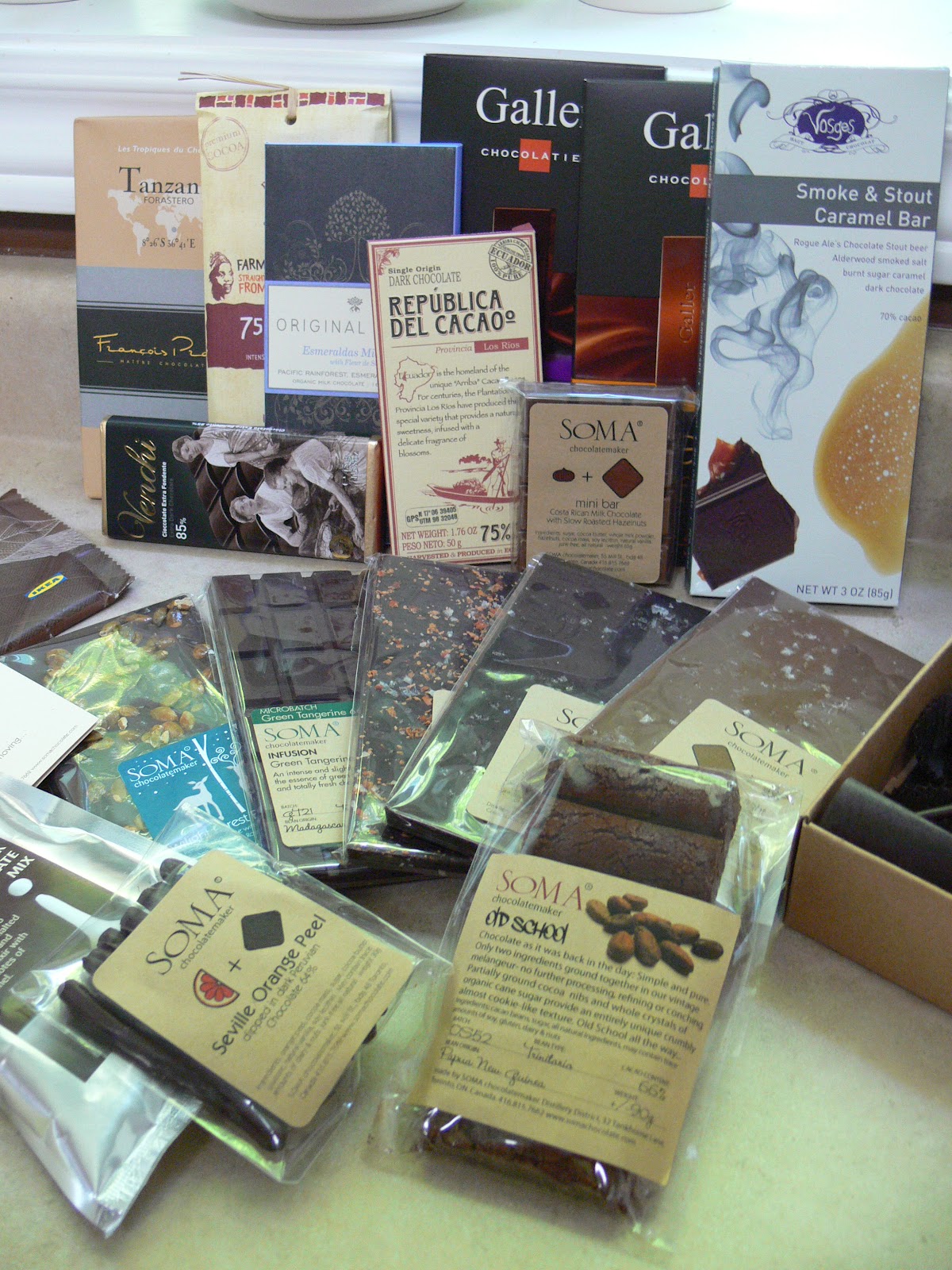
Fine Chocolate in Toronto - Shop for a large selection in little time

A few weeks ago, I went to Toronto with my family for a weekend getaway. I was fortunate to have a few hours to myself to do some fine chocolate shopping. Because I live on a rural Island in Northern Ontario, I have to make the most of my travel time to ensure that I arrive back home with a good supply of fine chocolate.

So with limited time to look, I immediately started at Soma Chocolatemaker, knowing that their bean-to-bar chocolate is always top quality and always offers a variety of interesting flavours. The following day I checked out mcewan's food market to look for a selection of international chocolate bars.

I zipped into Soma's newest location on King Street at about 8:45p.m. on Saturday evening. Thankfully they have great store hours. The King Street location was laid out very differently than I recalled from the Distillery District store;  it had a very distinct "cafe" feel to it.  I could see myself spending hours there drinking hot chocolates while relaxing, completely surrounded by chocolate. It really is a chocolate-lover's dream.

Besides the abundance of Soma-made products, they also carry a small selection of international chocolate bars.  For me, this was a highlight to my visit because I wanted to take home a great supply of chocolate products that I cannot find in my local area.  And it appeared that Soma had strategically found comparative products for tasting parties. I took home a selection of 75% single origin bars from chocolate makers like Original Beans, Pralus and Medécasse.

Although I have ordered chocolate bars from Soma online, nothing compares to standing in the store in front of the truffle and filled chocolate display while someone fills a box of my personal selections.  My favourites are the 8yr Aged Balsamic Vinegar and the "Sparky" Gianduja chocolate laced with poprocks - it is true kid-candy for the gourmand adult.  I also loved that Soma makes a range of chocolate ganache's from different single origin chocolate.  I bought all five and enjoyed each one, never really deciding on the origin that I liked best.

It was also fun to see what new products were on the shelves, like the Soma "Old School" bar or the milk chocolate version of their Starry Night bar - two chocolates that I might not have purchased had I read their description on a website.

On Sunday afternoon, I had a special chocolate-shopping trip in mind. Mark McEwan, the Canadian celebrity chef from the Food Network, created an upscale grocery store that offers "a food experience like no other". mcewan's is located at the Shops at Don Mills at 38 Karl Fraser and luckily I was staying close by.  I had never been there but had heard about it.  What I found was exactly as they promise on their website: many hard-to-find and specialty fine foods as well as a lovely selection of chocolate.

My favourite part of the store (aside from the Valet parking) was the area devoted to chocolate. There was a large glass counter display of filled chocolates and truffles made by Galler, a Belgian chocolate maker, along with a selection of Galler`s chocolate bars.  In addition, an aisle display nearby offered a selection of chocolate bars that included Vosges, an American brand out of Chicago, some single origin chocolate bars and all sorts of chocolaty confections.  mcewan's grocery store is definitely a great place to refill your fine chocolate supply.

I purchased a range of chocolates, including a small selection of Galler's filled chocolates, which I enjoyed (all of them!) later that day. There was not a huge supply of Vosges, as I had anticipated, but luckily the Vosges chocolate bars that were there, I had not yet tried.  I picked up the Vosges Smoke & Stout Caramel Bar, which pairs beer and chocolate into an oozy, gooey caramel-filled chocolate.  If you have never tried the wonderful flavours of Vosges Haut Chocolat, I highly recommend this as your starting point.

So after just two short shopping trips in Toronto and parting with a little under $200, my chocolate-tasting cabinet is refilled and ready to get me through the summer months, while I anxiously await the cooler weather when I can start ordering online again.

When I am next in Toronto, I plan to check out at least one of the three Pusateri's upscale grocery stores because they carry a selection of fine chocolate from Belgium, Italy and more, as well as fine chocolate gift baskets. And there are so many other chocolate shops in Toronto, such as: MoRoCo Chocolat on Yorkville Avenue, Stubbe Chocolates on Dupont Street, Ambiance Chocolat on Queen Street East and many, many more that I have yet to learn about. If you know of great chocolate in Toronto, please feel free to add it to the Comments below!

Links to Soma and McEwan's: 

McEwan's grocery store information and location details: http://mcewan.mcewangroup.ca/about/
It certainly was a food experience like no other, and I highly recommend a trip there if you are a self-proclaimed 'foodie'.

Soma information and location details: http://www.somachocolate.com/SOMA_home.html

Two locations at: 443 King Street West and the Distillery Historic District at 55 Mill Street.


Thursday, June 28, 2012

Hummingbird Chocolate makes me want to fly . . . to Ottawa!

Long ago, if you wanted to make chocolate bars, truffles, chocolate showpieces or filled chocolates, you had to roast and grind the beans yourself. Then, chocolate manufacturers started popping up in the early 1900s. They began roasting, grinding, mixing and conching and essentially creating a final chocolate product that small chocolatiers could buy and melt down to create their own confections. This made work easier for chocolatiers, who could then focus on the artistic side of working with chocolate, rather than the cumbersome, equipment-heavy and rather messy side of chocolate making.

Since then, chocolate manufacturers have industrialized, internationalized and considerably grown in size.  Companies like Valrhona, Callebaut, Hershey, and others have become international giants who still supply chocolatiers all over the world with finished and semi-finished chocolate products. Raw cacao is purchased in large quantities, mixed and processed in ways that remove a lot of the true cacao bean flavours. Vanilla or artificial `vanillin` is added in large quantities to improve the flavour, along with refined sugars.
All this industrialization and over-processing has lead to the recent emergence of many small bean-to-bar manufacturers in North America. Their goal is to coax out the true flavours of the cacao bean by making chocolate in small batches, and usually by using non-commercial or antique equipment. Other bean-to-bar makers get their start for other reasons: they want to support small farmers in developing countries, they want to create an organic chocolate brand or they want to preserve the healthy antioxidants in chocolate.
This bean-to-bar chocolate-making trend has created a wonderful variety of chocolate bars for chocoholics like me to taste and compare.  And now, Canadians are beginning to get in on the action. The newest bean-to-bar maker, Hummingbird Chocolate Maker, has opened its shop in Ottawa, Canada`s capital. According to their website, they craft “small batches of dark chocolate directly from cacao beans” in their workshop. And from my communications with Erica, one of the founders of Hummingbird, they are clearly very passionate about their craft.

Hummingbird has just gotten its start and in fact, the chocolate that I acquired from them said “test batch” on the packages indicating that they are still perfecting their chocolate recipes.  I have tried making chocolate from the bean and I can easily see how a chocolate maker might change the recipe many times before deciding on a final product.  That is both the science and the art of the artisan chocolate maker.

I tried three of Hummingbird's 70% dark single origin chocolate bars: Hispaniola, Venezuela and Talamanca.  I was impressed with all three. I found Talamanca to be the tangiest with a zest that was remarkable. My favourite was the Hispaniola - also very tangy with tropical fruit overtones and coconut (like a Pina Colada). In fact the Hispaniola chocolate bar reminded me of some Hawaiian chocolate that I recently fell in love with.

Oddly, after spending years believing that Venezuela has the most superior cacao beans, I liked the Venezuela the least of the three.  Do not get me wrong; I liked it, but felt it had a flatter flavour in comparison.  Venezuelan chocolate is so popular because it has a milder flavour and appeals to the general public (for wine lovers, that is like a Shiraz compared to a complex Cabernet or Old Vines Zinfandel). For me, I like a full-flavoured chocolate with a lot of tang, bitterness and some acidity.


All three chocolate bars offered the full flavour of the cacao bean, which was also not inhibited by vanilla or any additiona flavourings. I could tell from the taste, even before Erica told me, that traditional methods were used to make the chocolate, which preserved the flavours of the beans.


I highly recommend - to anyone in the Ottawa area or visiting Ottawa soon - that you give Hummingbird's chocolate a try. They have a great range of single origin chocolate that would make any chocolate-tasting party a success and their chocolate is made with Fair Trade and Organic beans.
Although they do not yet sell online, they are available at the Ottawa Farmer's Market at Brewer Park on Sunday's. Hummingbird also plans to soon sell their chocolate at local stores. Look for thier Ecuador single origin chocolate bar, which is back now after having briefly run out.

If you are just learning about bean-to-bar chocolate making, Hummingbird has a great and slightly humorous description of making chocolate on their website.  Check it out: http://hummingbirdchocolate.com/makingchocolate/


The package details from the chocolate bars that I tasted this week are:


70% Hispaniola Single Origin (La Red Trinitario Cacao beans Dominica Republic), 50g
Hummingbird Chocolate Maker (Ottawa, Canada)
Fair Trade and Organic Chocolate “test batch”, batch #32 (Test Batch)
Ingredients: Organic cacao beans, sugar, cocoa butter.

70% Venezuela `single origin` (Trinitario cacao beans from Venezuela), 50g
Hummingbird Chocolate Maker (Ottawa, Canada)
Fair Trade and Organic Chocolate “test batch”, batch #33 (Test Batch)


Ingredients: Organic cacao beans, sugar, cocoa butter.


70% Talamanca `single origin` (Trinitario cacao beans from Bri-Bri farmers in Costa Rica), 50g
Hummingbird Chocolate Maker (Ottawa, Canada)
Fair Trade and Organic Chocolate “test batch”, batch #34 (Test Batch)
Ingredients: Organic cacao beans, sugar, cocoa butter.